
Written by Craig Fearn
Director
Last updated: 26 March 2026
Part of our complete guide: 23 Restaurant Marketing Ideas That Fill Tables (Not Just Get Likes)
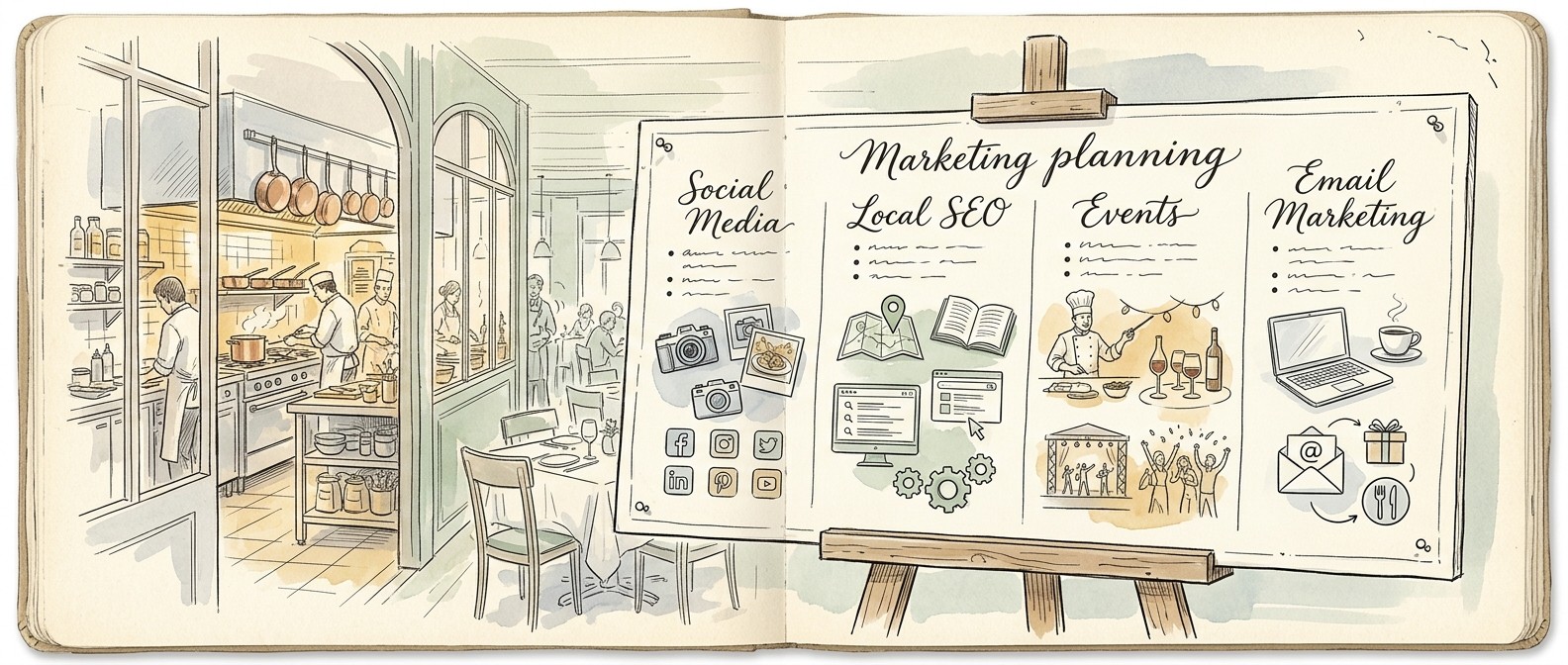
Most restaurant owners we speak to across Cornwall and the South West don’t have a marketing problem. They have a ‘throwing stuff at the wall’ problem. A bit of Instagram here, a half-finished Google listing there, maybe a leaflet drop that cost more than it brought in. Sound familiar? This guide gives you a real restaurant marketing strategy - a structured plan that ties each channel to bookings, covers, and repeat visits.
We wrote this for UK restaurants: independents, small groups, cafes, gastropubs. The advice covers British dining habits, UK platforms, and the cost pressures defining hospitality now. For a broader list of tactics, start with our restaurant marketing ideas pillar guide. This article stitches those ideas into a strategy that works.
TL;DR
A restaurant marketing strategy prioritises 3-4 channels that drive bookings, not random activity across every platform. Google Business Profile is the single highest-return free channel for most restaurants. Email marketing returns roughly £36 for every £1 spent. Budget 3-6% of gross revenue on marketing, start with the free tier, and measure covers, booking source, email list growth, and GBP actions monthly.
| Channel | % of Budget | Primary Goal | Measurable KPI |
|---|---|---|---|
| Google Business Profile & local SEO | 25–30% | Discovery by new diners | Profile views, direction requests |
| Social media (organic) | 20–25% | Brand building and community | Engagement rate, follower growth |
| Paid ads (Meta, Google) | 15–20% | Filling quiet periods | Cost per booking, ROAS |
| Email marketing | 10–15% | Repeat visits from existing diners | Open rate, redemption rate |
| Website & content | 10–15% | Converting searchers to diners | Booking conversions, bounce rate |
What Is a Restaurant Marketing Strategy and Why Does It Matter?
A restaurant marketing strategy is a written plan that sets out who you’re trying to reach, which channels you’ll use, what you’ll spend, and how you’ll measure success.
That sounds obvious. But here’s what separates a strategy from random activity: priorities. You can’t do everything at once - not while running a kitchen, managing staff, and watching food costs climb. The House of Commons Library records UK hospitality as 2.7 million jobs and about 4% of GDP, yet margins stay paper-thin. National Living Wage rises and employer National Insurance increases have added billions to the sector’s wage bill since April 2025. Marketing spend must earn its place.
A strategy forces you to answer three questions before spending a penny:
- Who are my best customers and where do they look for restaurants?
- Which channels give me the highest return for the lowest cost?
- What does success look like in 30, 90, and 180 days?
Without those answers, you’re guessing. And guessing is expensive.
Who Is Your Target Audience?
Your target audience isn’t ‘everyone who eats food’ - it’s the specific group of people most likely to book a table, come back, and tell their friends.
Think about your best customers now. The ones who book on a Tuesday, order a bottle of wine, leave a five-star review, and return next month. What do they share? Age range? Where they live? Couples, families, or work groups? That’s your starting point.
UK dining behaviour splits by generation. Younger diners (under 35) discover restaurants on Instagram and TikTok, read Google reviews obsessively, and expect online booking. Older diners respond to local press, word of mouth, and a strong Google Maps presence. Families search for ‘family-friendly restaurants near me.’ Date-night couples hunt for atmosphere and reviews. These patterns drive which social media platforms suit your venue.
Get specific. Write down two or three customer profiles. Name them if it helps. Then map every marketing decision back to those profiles. A gastropub targeting 35- to 55-year-old couples in a market town needs a different approach from a pizza place chasing university students. The channels change. The tone changes. The budget changes. Your restaurant brand identity should reflect who you’re trying to reach.
How Do You Set Up Google Business Profile for a Restaurant?
Claim your listing, complete every field, upload your menu, and respond to every review - this single step drives more walk-ins than almost anything else you can do for free.
BrightLocal’s 2025 research shows over 90% of consumers use the internet to find local businesses. When diners search ‘restaurant near me’ or your cuisine plus a town name, Google’s local pack - those three map results at the top - is what they see first. Your Google Business Profile decides whether you appear.
Here’s what to do, step by step:
- Claim and verify your listing at Google Business Profile. Verification usually involves a postcard or phone call.
- Choose the right primary category. ‘Restaurant’ is too broad. Pick something specific: ‘Italian restaurant,’ ‘Seafood restaurant,’ ‘Gastropub.’ Add secondary categories for additional reach.
- Fill in every field. Opening hours (including bank holidays), phone number, website link, menu URL, reservation link. Incomplete profiles rank lower.
- Upload your menu using Google’s menu editor. Diners increasingly expect to browse dishes, descriptions, and prices directly from search results.
- Add at least 10 quality photos. Exterior shots help people find you. Interior photos set expectations. Food photography sells dishes. Update images monthly - Google rewards fresh content.
- Respond to every review within 48 hours. Thank happy customers by name. Address complaints professionally. Never use copy-paste replies. Review responses influence both rankings and the next customer’s decision to book.
This isn’t a one-off task. Post weekly updates - special menus, events, seasonal changes. Treat your Google listing like a second homepage. For a step-by-step walkthrough, see our restaurant Google Business Profile setup guide. For a deeper look at local search, see our guide to website SEO services or learn about local SEO and how it fills tables.
What Role Does Social Media Play in Restaurant Marketing?
Social media builds desire and keeps your restaurant top of mind between visits - but only if you pick the right platforms and post consistently.
You don’t need to be on every platform. Pick two. According to Ofcom’s 2025 Online Nation report, Instagram reaches 44% of UK adults while Facebook reaches 66%, so for most UK restaurants, that’s Instagram and one other - Facebook for an older local audience, TikTok if your customers skew younger. That’s it. Two platforms done well will outperform five done badly.
Food is visual. Instagram was built for this. Post three to five times a week: dish close-ups, behind-the-scenes kitchen shots, team introductions, customer moments (with permission). Use local hashtags - #CornwallFood, #LondonEats, your town name. Stories and Reels get more reach than static posts in 2026, so film short clips of dishes being plated, cocktails being shaken, or the dining room filling up on a Friday night.
Still the largest social network in the UK by active users, and particularly strong with the 35-plus demographic. Share events, seasonal menus, and booking links. Facebook’s local groups can drive real footfall - join your town’s community group and contribute genuinely (don’t just spam promotions). For a complete breakdown on social strategy, read our social media marketing guide for small businesses.
What to post (and what not to)
- Do: Share your specials board, chef profiles, seasonal ingredients arriving, customer celebrations, behind-the-scenes prep.
- Don’t: Post generic stock food images, share only promotional content, or disappear for three weeks then post five times in a day.
- Do: Respond to every comment and direct message quickly - social platforms reward engagement with reach.
Consistency matters more than perfection. A slightly imperfect photo posted regularly beats a professional shoot that happens twice a year.
How Should UK Restaurants Use Email Marketing?
Email is the most profitable marketing channel for restaurants because you own the list, it costs almost nothing to send, and it drives repeat bookings directly.
According to Campaign Monitor’s 2024 benchmarks, restaurant emails see open rates around 40%, well above the 21% cross-industry average. Here’s what most restaurant owners get wrong: they don’t collect email addresses at all, or they collect them and never send anything. Both are missed opportunities.
Start building your list today. Add a sign-up form to your website. Train front-of-house staff to ask diners if they’d like to join your mailing list for priority booking and exclusive offers. Use your booking system - most platforms like ResDiary, DesignMyNight, and OpenTable capture email addresses with consent. Place a simple card on each table with a QR code linking to a sign-up page.
Then send something useful. Not every week. Once or twice a month is enough for most restaurants. Here’s a calendar that works:
- Monthly newsletter: New menu items, upcoming events, chef recommendations, a seasonal story.
- Occasional flash offers: ‘Book before Friday for 20% off midweek dining.’ Short deadline, clear call to action.
- Birthday and anniversary emails: Automated messages triggered by dates you’ve collected. ‘Happy birthday - here’s a complimentary dessert when you book this month.’ These have some of the highest open rates of any email type.
- Seasonal campaigns: Valentine’s Day, Mother’s Day, Christmas party bookings. Send these 4 to 6 weeks ahead - people plan restaurant visits earlier than you’d think.
Email isn’t glamorous. It won’t go viral. But a list of 2,000 local food lovers who’ve opted in is worth more than 10,000 Instagram followers who never visit. Our dedicated restaurant email marketing guide covers list-building, GDPR compliance, and automation in full. For more on building a content calendar around email, see our content marketing guide for small businesses.
Does Your Restaurant Need a Website in 2026?
Yes. A simple, fast, mobile-friendly website with your menu, opening hours, location, and a booking button is non-negotiable.
Some restaurant owners think Google Business Profile and social media are enough. According to TouchBistro’s 2025 data, 77% of diners visit a restaurant’s website before deciding where to eat. They’re not enough - for three reasons.
First, you don’t own your Google listing or your Instagram account. Platforms change algorithms, suspend accounts, and alter rules without notice. Your website is the one piece of digital real estate you control completely.
Second, your website is where SEO lives. Blog posts targeting ‘best Sunday roast in [your town]’ or ‘private dining [your area]’ bring in search traffic that social media can’t match over the long term. That’s how you show up when someone types a question into Google or an AI search engine and gets a direct answer. Our restaurant website design guide covers what your site needs, and our blog writing service explains how content marketing works for hospitality businesses.
Third, according to OpenTable’s UK dining data, over half of diners in major UK cities say they’d avoid a restaurant without online booking. Your website should make booking effortless - one click from the homepage, no more than two taps on mobile.
Keep your site simple. You don’t need fifty pages. You need:
- Homepage with atmosphere photos, a short welcome, and a prominent ‘Book a Table’ button.
- Menu page that loads quickly and reads well on phones (no PDF-only menus).
- Contact page with address, phone, map, and opening hours.
- About page telling your story - who you are, why you cook, what makes you different.
How Do Loyalty Programmes and Promotions Fit the Strategy?
Loyalty programmes turn one-time visitors into regulars, and they cost far less than acquiring a new customer through advertising.
Acquiring a new diner costs five to seven times more than keeping an existing one. That’s a well-worn statistic, but it’s still true - and it’s especially relevant when marketing budgets are tight. Research from the Department for Business and Trade shows that nearly 99.6% of food and drink businesses are SMEs, meaning most restaurants compete on relationships, not advertising spend.
Loyalty doesn’t have to mean a complicated app. Simple works. A stamp card for coffee shops and casual diners. A members’ email list with early access to event bookings and seasonal menus. A ‘dine five times, get the sixth starter free’ programme tracked through your booking system. The mechanism matters less than the consistency.
Promotions should be tactical, not constant. According to Deloitte’s Consumer Review, 39% of UK consumers are actively seeking deals when dining out, making targeted promotions an effective way to fill quiet nights. Midweek offers fill quiet nights. Early-bird menus attract price-conscious diners without devaluing your brand. ‘Bring a friend’ incentives expand your customer base through the strongest channel of all: personal recommendation. Avoid blanket discounting - 29% of UK diners actively search for offers, and you want to attract them without training everyone to wait for a deal. Our guide to restaurant promotion ideas covers specific offers that drive covers without eroding margins. For a seasonal approach, see our seasonal restaurant marketing calendar.
How Do You Measure Whether Your Restaurant Marketing Strategy Is Working?
Track four numbers every month: covers, booking source, email list growth, and Google Business Profile actions.
Marketing without measurement is guesswork. According to HubSpot’s 2025 research, businesses that track marketing ROI are 1.6 times more likely to receive higher budgets the following year. But you don’t need a complicated dashboard. Four metrics tell you most of what you need to know.
- Total covers per week. The ultimate measure. Is the number going up, down, or staying flat? Compare like-for-like periods (this February vs last February, not February vs December).
- Booking source. Where are reservations coming from? Direct website? Google? Instagram link? Phone call after seeing a Facebook post? Ask new customers how they found you. Even an informal tally gives you direction.
- Email list size and open rate. A growing list means your reach is expanding. Open rates above 30% are strong for restaurants - if you’re below 20%, your subject lines or send frequency need attention.
- Google Business Profile insights. Track searches, direction requests, phone calls, and website clicks each month. These numbers show whether your local visibility is improving.
Review these monthly. Spot trends over quarters, not days. If Instagram is driving profile visits but not bookings, the problem might be your booking link, not your content. If email open rates are high but click-through is low, your offer or call to action needs work.
What Should a Restaurant Marketing Budget Look Like?
Most UK restaurants should spend between 3% and 6% of gross revenue on marketing, but the smartest spending starts at zero and scales up from there.
According to Restaurant Growth’s 2025 analysis, the average restaurant allocates 3–6% of gross revenue to marketing. Here’s what a realistic breakdown looks like for an independent UK restaurant doing around half a million pounds a year in revenue:
- Free tier (do this first): Google Business Profile optimisation, organic social media, email list building, review management. Cost: your time.
- Low-cost tier (under GBP 500/month): Email marketing platform (Mailchimp or MailerLite), professional food photography twice a year, occasional boosted social media posts for events.
- Growth tier (GBP 500–1,500/month): SEO and website maintenance, targeted Facebook and Instagram ads for specific campaigns (Valentine’s, Christmas bookings), local food blogger collaborations.
- Scale tier (GBP 1,500+/month): Ongoing hospitality marketing agency support, paid search campaigns, PR, influencer partnerships.
Start with the free tier. Seriously. Many restaurants haven’t even finished setting up their Google profile properly, and that alone can move the needle. Only spend money when you’ve exhausted what you can do for free - and when you can track the return on every pound.
How Do You Bring It All Together?
Write your strategy down, assign responsibility for each channel, and review it quarterly.
According to CoSchedule’s 2025 marketing research, marketers who document their strategy are 414% more likely to report success. A restaurant marketing strategy doesn’t need to be a 40-page document. One page works. Write down your target customers. List the three or four channels you’ll focus on. Set a monthly budget (even if it’s GBP 0). Define what success looks like at 90 days.
Then assign someone to each task. Who’s posting on Instagram? Who’s replying to Google reviews? Who’s sending the monthly email? If the answer to all three is ‘me, when I get a minute,’ nothing will happen consistently. Delegate where you can. Consider outside help where it makes sense - a local marketing partner who understands your area can take the pressure off while you focus on the kitchen.
Review every quarter. What worked? What didn’t? Where did bookings actually come from? Adjust and go again. Marketing isn’t a project with a finish line. It’s an ongoing process, and the restaurants that win are the ones that keep showing up - online and in person. If you want quick wins you can act on immediately, our restaurant marketing tips guide covers the fastest actions, while our guide to attracting restaurant customers goes deeper on the customer acquisition side.
Frequently Asked Questions
How much should a UK restaurant spend on marketing?
Most UK restaurants should budget between 3% and 6% of gross revenue. A restaurant turning over GBP 500,000 a year would spend roughly GBP 15,000 to GBP 30,000 annually. Start with the free channels - Google Business Profile, email, and organic social media - then reinvest profits into paid advertising as you track what works.
What is the most effective marketing channel for restaurants?
Google Business Profile. Over 90% of diners check Google before choosing where to eat. An optimised profile with strong reviews, current photos, and an up-to-date menu appears in local search results and Google Maps at no cost. It’s the single highest-return channel for most independent restaurants.
How long does it take for a restaurant marketing strategy to show results?
Expect early results from Google Business Profile optimisation and email within 2 to 4 weeks. Social media typically builds momentum over 1 to 3 months. SEO takes longer - most restaurants see meaningful organic traffic improvements within 3 to 6 months. The key is consistency: strategies that stop and start rarely gain traction.
Do I need social media for my restaurant?
Yes, but pick two platforms and do them well rather than spreading across five. For most UK restaurants, Instagram and Facebook deliver the best results. Post three to five times a week with real food photos, behind-the-scenes content, and event announcements. Consistency matters more than polish.
Is email marketing worth it for a small restaurant?
Absolutely. Email returns roughly £36 for every £1 spent and reaches people who have already eaten with you. Build your list through bookings and WiFi sign-ups, then send one to two emails per month covering new dishes, events, and exclusive offers. A list of 500 engaged subscribers is more valuable than 10,000 social followers.
How do I track where restaurant bookings come from?
Use unique booking links or promo codes in each marketing channel. Ask new customers how they found you at the point of booking. Check Google Business Profile insights monthly for searches, direction requests, and website clicks. Even an informal tally helps you identify which channels drive real covers.
Ready to Build Your Restaurant Marketing Strategy?
You don’t need a massive budget. You don’t need a marketing degree. You need a clear picture of your customer, a focus on the channels that matter most, and the discipline to show up consistently. Start with your Google Business Profile. Build your email list. Post regularly on one or two social platforms. Measure what you’re doing. Then improve it.
If you’d rather have someone handle this while you focus on running your restaurant, we can help. Outcome Digital Marketing works with UK restaurants and hospitality businesses on local SEO, content, and social media strategy. Get in touch and tell us about your restaurant - we’ll show you where the biggest opportunities are.
Cornwall restaurant owner?
See our dedicated restaurant marketing Cornwall service page for local SEO, Google Business Profile management and website design tailored to Cornwall restaurants, cafes and pubs.
Need help with this?
We work with Cornwall small businesses on the exact challenges covered in this article. Free 30-minute call, no pressure.
Get in touchCraig Fearn
Director
Craig is Director of Outcome Digital Marketing. He brings over a decade of C-suite advisory experience, having advised senior executives and boards on organisational strategy before focusing on the marketing decisions that move the needle for smaller businesses. As a Fellow of the Royal Society for Public Health (FRSPH) and Fellow of the Chartered Management Institute (FCMI), he applies evidence-based thinking to marketing - helping Cornwall and UK businesses make informed decisions backed by research, not hype.