
Written by Craig Fearn
Director
Last updated: 26 March 2026
Part of our complete guide: 23 Restaurant Marketing Ideas That Fill Tables (Not Just Get Likes)
Your food might be brilliant. But if nobody remembers your restaurant’s name two days after eating there, you’ve got a branding problem. Most independent restaurants pour everything into the menu and leave their brand to chance - a hastily picked name, a logo from a mate’s nephew, colours chosen because the owner liked them. That approach doesn’t cut it anymore.
Restaurant branding is not about being flashy. It is the reason diners pick you over the place next door, the feeling they get walking through your door, and what sticks when someone asks where to eat. This guide covers naming, visuals, tone of voice, and what happens at the table. If you are opening somewhere new or rethinking a stale restaurant, start here.
For broader strategies on filling seats, read our restaurant marketing ideas guide - it covers the full picture from social media to local SEO.
TL;DR
Restaurant branding is the reason diners pick you over the place next door. Consistent branding across every touchpoint can increase revenue by up to 23% (Marq). Start with a clear concept, build a simple visual identity (logo, two to three colours, one typeface), write a short tone-of-voice guide, and apply it everywhere at once - menus, signage, website, and social media. Staff training is the final piece: your team delivers the brand promise in real time.
| Branding Element | Cost to Implement | Impact on Revenue | Timeline |
|---|---|---|---|
| Logo & visual identity | £200–£2,000 | High - first impression at every touchpoint | 2–4 weeks |
| Menu design & layout | £100–£500 | High - influences average spend per cover | 1–2 weeks |
| Tone of voice guide | Free–£300 | Medium - consistency builds recognition | 1 week |
| Interior & signage | £500–£5,000+ | High - creates shareable moments | 2–8 weeks |
| Staff training on brand | Free (internal) | Very high - delivers brand promise live | Ongoing |
Restaurant Branding and Identity: What It Actually Means
Restaurant branding is everything that shapes how diners perceive your restaurant - from the logo on your napkin to the way your staff greet a table.
Think of branding as a promise. It tells people what to expect before they’ve read a single review. Your concept, values, atmosphere, and online voice all feed into that promise. When the experience matches the expectation, people come back. When it doesn’t, they quietly disappear.
Why this matters commercially: research from Marq (formerly Lucidpress) shows consistent branding across all channels can lift revenue by up to 23%. In an industry where margins often sit around 3-5%, that’s the difference between surviving and thriving.
IBISWorld’s 2024 UK industry data puts the UK restaurant industry at roughly £18.7 billion in 2023, with over 36,000 licensed food-led premises competing for attention. Standing out isn’t optional. It’s survival. Branding is how you stand out without slashing prices.
How Do You Choose a Restaurant Name That Sticks?
The best restaurant names are short, pronounceable, and spark curiosity - without needing explanation.
Your name is the first piece of branding anyone encounters. BrightLocal’s 2025 Local Consumer Review Survey shows 98% of consumers use the internet to find local businesses, and your name is what they search for first. It appears on Google results, on lips during word-of-mouth recommendations, and on every piece of signage and packaging you’ll ever produce. Get it wrong and you fight uphill from day one. Get it right and the name does half the marketing for you.
A few principles that hold up across thousands of successful restaurants:
- Keep it short. One to three words. People need to remember it after hearing it once at a dinner party.
- Make it pronounceable. If someone reads it on a sign and can’t say it aloud with confidence, you’ve lost them.
- Hint at the experience. The name doesn’t need to spell out your cuisine, but it should evoke something - warmth, energy, heritage, place.
- Check availability. Search for the domain name, social media handles, and Companies House before you get attached to anything.
- Think long-term. A name tied too tightly to a trend - or a single dish - limits you if the concept evolves.
Local relevance works well, particularly for independent restaurants. Incorporating a neighbourhood name, a nearby landmark, or a piece of local history gives your restaurant a sense of place. People connect to that. It feels rooted rather than generic.
One often-overlooked test: say the name in a noisy pub. Can someone hear it clearly and spell it roughly right when they search for it afterwards? If not, reconsider.
What Makes Restaurant Visuals Stick?
A strong visual identity ties mark, colours, fonts, and imagery into a system diners recognise instantly - on Instagram or walking past your frontage.
Every colour, font, and photograph tells diners who you are. Here is how to handle each piece.
The mark
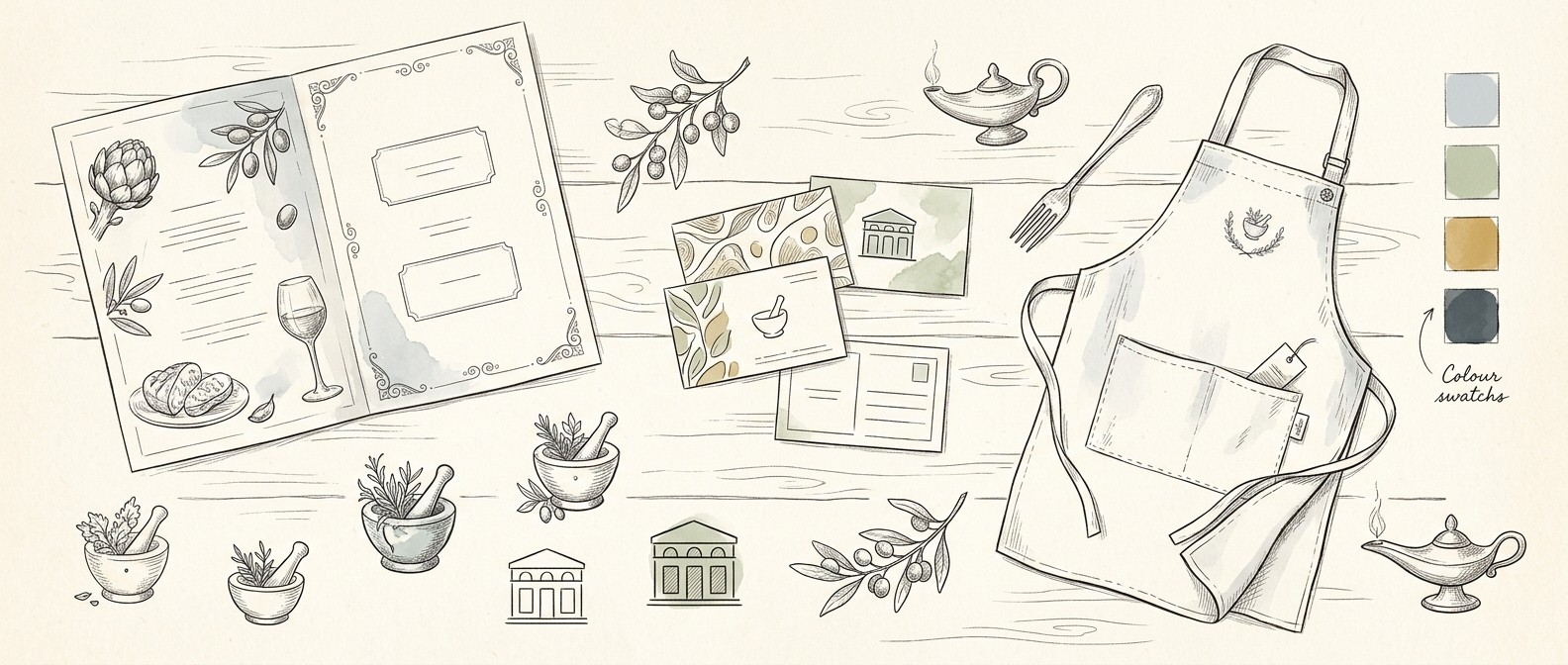
Your logo needs to work everywhere - embroidered on an apron, shrunk to a social avatar, printed on a till receipt, blown up on a shop front. Renderforest’s 2024 research shows 75% of consumers recognise a brand by its mark. Simplicity wins. Detailed marks lose legibility at small sizes and cost more to reproduce. A wordmark (your name in a distinctive font) usually works better for restaurants than an elaborate symbol.
Colour
Colour is psychological, not aesthetic. Research in Frontiers in Psychology shows red increases heart rate and stimulates appetite, orange encourages conversation, and blue suppresses hunger but creates calm - which is why fine dining leans on deep navy while fast-casual spots use warm reds and oranges.
Pick two or three core colours and use them on menus, website, social, signage, takeaway packaging. When diners see the combination, they should think of your restaurant before they read the name.
Typography
Fonts communicate personality faster than most owners realise. Research in the Journal of Marketing Management confirms typography shapes consumer perceptions of personality and quality. A chunky slab serif says something different to an elegant script. Pick one font for headings and one for body, and use them consistently across menu, website, A-board, and social posts.
Photography
Stock photos damage trust. MDG Advertising reports 67% of consumers rate image quality above product description. Four in five diners check websites before visiting, and they spot generic stock instantly. Pay a professional to shoot your actual food, your actual space, your actual team. Set a consistent style - lighting, angles, editing - and keep it across every channel.
How Should a Restaurant Develop Its Tone of Voice?
Tone of voice is how your brand sounds in writing - and it should hold whether you are writing a menu line, an Instagram caption, or a reply to a Google review.
Most restaurants don’t think about this. Salesforce’s State of the Connected Customer report shows 75% of consumers expect a consistent experience across every channel. Most restaurants write website copy in one voice, social in another, the menu in a third. Diners feel the disconnect even if they can’t articulate it.
Start by asking three questions:
- If your restaurant were a person, how would they talk? Warm and familiar? Witty and irreverent? Refined and measured?
- What words would you never use? (This is often more telling than what you would use.)
- How do you want diners to feel after reading anything from you? Excited? Relaxed? Curious?
Write the answers down. Build a one-page voice guide with three or four describing words (e.g. friendly, knowledgeable, slightly cheeky, never corporate). Share it with anyone who writes on behalf of the restaurant - social manager, review responder, web editor.
Menu descriptions deserve particular attention. Research by Wansink, Painter, and Van Ittersum published in Organizational Behavior and Human Decision Processes found that descriptive menu labels can increase sales by up to 27%. That’s the difference between ‘chocolate cake’ and ‘warm Valrhona chocolate fondant with Cornish clotted cream.’ The brand voice brings those descriptions to life. Our content marketing guide for small businesses covers how to develop a voice that works across all your channels.
How Does Interior Design Shape Your Restaurant Brand?
Your space is where the promise becomes real - every surface, sound, and smell either reinforces the identity you built online or undermines it.
Branding does not stop at the front door. PwC’s Global Consumer Insights Survey shows 73% of consumers say experience drives purchasing decisions, and in hospitality the physical environment is the experience. Walk into any restaurant you admire and you notice the details: lighting sets the mood, furniture tells a story, music sits at the right volume. None of that happens by accident. It is strategy expressed through physical space.
Consider these touchpoints and whether they reinforce your brand:
- Entrance and signage. The exterior is your first in-person impression. Does it match your online presence? Or does someone arrive expecting the vibe from your Instagram and find something completely different?
- Furniture and layout. Communal tables say ‘sociable and casual.’ Widely spaced linen-clad tables say ‘occasion dining.’ Your furniture choices send signals before anyone sits down.
- Lighting. Bright lighting suits cafes and breakfast spots. Dim, warm lighting suits evening restaurants. Harsh fluorescents suit neither.
- Music. The playlist is part of the brand. A jazz soundtrack tells a different story to a curated indie folk set. And no music at all tells its own story - usually the wrong one.
- Staff presentation. Uniforms (or a deliberate lack of them) contribute to the brand. Aprons, name badges, the language staff use - all of it matters.
Here is what most owners miss: consistency between online presence and physical space is what builds trust. If Instagram shows moody, candlelit photography but the room has strip lighting and plastic menus, the promise is broken. Diners do not forgive that disconnect easily.
Why Is Your Digital Presence Central to Restaurant Branding?
Most diners meet you digitally before they ever set foot inside - making the website, social profiles, and Google listing the true front door of your restaurant.
Around 80% of diners check a restaurant online before visiting. Your digital presence is not secondary to the room. For many, it is the first impression.
A few non-negotiable digital branding requirements:
- Website. Clean, fast, mobile-friendly. Your brand colours, typography, and photography should carry through. Menu, location, hours, and a booking option should take no more than two taps to reach. Our restaurant website design guide covers what your site actually needs, and if you need something effective without a massive budget, a well-built one-page website can do the job beautifully.
- Google Business Profile. This is where most local discovery happens. Use your brand photography - not blurry phone snaps. Keep your hours accurate, respond to reviews in your brand voice, and post regular updates.
- Social media. Pick one or two platforms and do them properly rather than spreading thin across five. For restaurants, Instagram and TikTok tend to deliver the best results because food is inherently visual. Our social media marketing guide covers platform selection and content strategy for small businesses.
- Online menus. PDFs are clunky and hard to read on mobile. Use an HTML menu page with proper formatting. It’s better for search engines, better for diners, and easier to update when dishes change.
Data from SevenRooms’ 2025 UK Restaurant Trends report shows that 45% of diners discover new restaurants through social media. That means nearly half your potential customers form their first impression of your brand through a screen. The visual identity, tone of voice, and consistency you’ve built offline must translate directly to every digital channel.
How Do You Keep Your Restaurant Brand Consistent Across Every Touchpoint?
Consistency means a diner gets the same feeling from your Instagram post, your takeaway box, the front-of-house greeting, and the printed menu - every time.
This is where most restaurants fall apart. Marq reports 68% of businesses say consistency contributed 10%+ to revenue growth, yet only 30% enforce guidelines. Owners invest in a good mark, build a decent website, then let everything else drift. Social looks different from the menu. Signage uses a different font. Staff describe the place differently from the website. Death by a thousand small inconsistencies.
The fix is a brand guidelines document. It doesn’t need to be fifty pages. A clear, practical guide covering the following is enough:
- Mark usage rules (sizes, spacing, what not to do)
- Colour codes (exact hex values, RGB, and CMYK for print)
- Type system (which fonts, what sizes, what purpose)
- Photography style guidance
- Tone of voice summary with example phrases
- Social media templates or at least a clear brief for whoever creates content
Share it with every single person who touches your brand - your designer, your printer, your social media manager, your front-of-house team leader. When everyone works from the same playbook, consistency follows naturally.
This matters even more if you’re thinking about growth. Opening a second location, launching a delivery service, or bringing in new staff all test brand consistency. Without guidelines, the brand fragments quietly until it doesn’t feel like the same restaurant anymore.
Why Are Your Staff the Most Important Part of Your Brand?
Your team delivers the brand in real time - no amount of design rescues a poor interaction at the table.
Every touchpoint discussed so far - mark, colours, tone, atmosphere - sets an expectation. Staff either meet it or break it. That is enormous brand equity resting on who you hire and how you train them.
Effective staff brand training doesn’t mean scripting every interaction. It means helping your team understand what the brand stands for and trusting them to express that naturally. Brief them on three things:
- The one-sentence brand promise. What are we here to deliver? If everyone on the team can articulate this in their own words, you’re in good shape.
- The voice. How do we talk to guests? Formal or relaxed? First names or sir/madam? This should match your written tone.
- The non-negotiables. What must always happen (e.g. greeting within 30 seconds, water without asking) and what must never happen?
The hospitality sector’s staffing challenges make this harder. With vacancy rates still 48% above pre-pandemic levels according to UKHospitality, retention matters more than ever. A clear, well-communicated brand identity actually helps here - people want to work somewhere with a sense of purpose and personality. It gives staff something to believe in beyond just serving plates.
When Should a Restaurant Consider Rebranding?
Rebrand when the gap between what you promise and what diners experience has grown too wide to close with small fixes.
Rebranding is expensive and disruptive. Rebrand’s global study found 74% of S&P 100 companies rebranded inside seven years, but only those with a clear strategic reason saw positive returns. Do not do it because you are bored of the mark. Do it because concept, audience, market, or ambition has outgrown the identity.
Signs that a rebrand may be warranted:
- Your reviews consistently describe an experience that doesn’t match what you’re trying to be
- You’ve changed your menu concept significantly but the brand still reflects the old one
- Your target audience has changed (perhaps from families to date-night couples)
- Your visual identity looks outdated compared to newer competitors
- You’re expanding to new locations and the current brand doesn’t travel well
If you do rebrand, commit fully. Half-measures - updating the logo but keeping the old menus, or changing the website but not the signage - create more confusion than the original problem. A rebrand is all or nothing.
What Are the First Steps to Building a Restaurant Brand From Scratch?
Start with strategy, not design - define who you are and who you serve before anyone opens a design programme.
Here’s a practical sequence that works whether you’re launching a brand-new restaurant or rebuilding one:
- Define the concept in one paragraph. What do you serve, to whom, and what makes the experience distinct? If you cannot articulate this clearly, the brand lacks direction.
- Research your competitors. Visit them. Study their online presence. Identify what they do well and where the gaps sit. Your brand should fill a space no one else occupies locally.
- Choose your name. Use the principles above. Test it with real people - not just your partner and your chef.
- Develop the visuals. Work with a designer who understands hospitality. Brief them thoroughly on concept, audience, and local competition. This is investment, not cost.
- Write your tone of voice guide. Even a half-page document gives everyone a consistent starting point.
- Apply it everywhere, at once. Menus, signage, website, social media profiles, staff uniforms, takeaway packaging. The launch should feel cohesive.
- Build your digital presence. Website first, then Google Business Profile, then social media. Each one should feel unmistakably like the same brand. For guidance on getting your site right from the start, our piece on website design principles covers the fundamentals that apply to any small business.
- Train your team. Share the brand guidelines. Explain the ‘why’ behind the choices. Give them ownership of bringing the brand to life.
- Monitor and refine. Listen to what diners say - in reviews, on social media, face-to-face. If they consistently describe your restaurant differently from how you describe it, the brand needs adjusting.
What Are the Biggest Restaurant Branding Mistakes to Avoid?
The costliest mistake is treating brand work as a one-off design project rather than an ongoing commitment to consistency.
From working with hospitality businesses across Cornwall and the South West, we see the same errors. Stackla (now Nosto) found 90% of consumers say authenticity matters when choosing which brands to support, which makes these mistakes more costly:
- Copying competitors. A brand should set you apart, not blend you in. If your visuals could belong to three other restaurants in town, they are not doing the job.
- Designing for yourself, not your audience. You might love minimalist Scandinavian design. But if your target audience is families looking for a relaxed Sunday lunch, cold minimalism won’t connect.
- Neglecting the online-to-offline gap. Your Instagram creates expectations. Your restaurant must deliver on them. This disconnect is the single most common reason diners feel let down.
- Skimping on photography. One professional shoot costs less than you think and delivers months of content. Phone snaps with bad lighting cost nothing upfront and damage trust daily.
- Inconsistent social media. Posting sporadically with no visual coherence tells people you’re disorganised. Better to post three times a week with consistent quality than daily with no direction.
- Ignoring reviews. Unanswered reviews - positive or negative - are missed branding opportunities. Every response is a chance to demonstrate your brand voice and values.
Frequently Asked Questions About Restaurant Branding
What is restaurant branding and why does it matter?
Restaurant branding shapes how diners perceive you - through name, visuals, tone of voice, interior, and the dining experience. Consistent branding builds recognition and loyalty. Research shows it can lift revenue by up to 23%, which matters in an industry with notoriously tight margins.
What are the key elements of a restaurant brand identity?
Core elements: name, mark, colour palette, typography, photography style, tagline, tone of voice, menu typography, interior atmosphere, staff presentation, and digital presence. These are not independent pieces - they are a system. Each one should reinforce the others across every touchpoint.
How much does restaurant branding cost in the UK?
It depends on scope. A mark and basic guidelines run £500-£2,000 from a freelance designer. A full identity package - covering mark, colours, typography, menu, signage concepts, and full guidelines - typically costs £3,000 to £15,000. View it as investment with measurable returns, not sunk cost.
How does colour psychology affect restaurant branding?
Colour shapes appetite and mood. Red raises heart rate and stimulates hunger - which is why fast-food brands rely on it. Orange encourages social interaction, popular for family restaurants and cafes. Blue suppresses appetite but promotes calm, suiting fine dining. Pick colours that match the dining experience you want to create, not personal preference.
How often should a restaurant update its branding?
Review your brand annually against customer feedback and competitor activity. Small refreshes - new photography, a tweaked palette - can happen without a full rebrand. Only consider a complete rebrand when concept, audience, or market has fundamentally shifted.
What is the biggest restaurant branding mistake?
Inconsistency between online presence and the physical room. If Instagram shows moody, candlelit photography but the restaurant has strip lighting and plastic menus, the promise breaks. Diners notice immediately, and trust erodes faster than any single bad review.
Ready to Build a Brand Diners Remember?
A strong restaurant brand does not happen by accident. It takes clear strategy, consistent execution, and a story that diners resonate with. Whether you are starting from scratch or your current brand is not pulling its weight, these principles give you a foundation to build on.
If you want help translating your restaurant’s identity into a digital presence that actually works - from website design to content strategy - get in touch. We work with hospitality businesses across Truro, Falmouth, Newquay, and the wider South West. You can also explore our restaurant email marketing guide and tips on optimising your Google Business Profile for restaurants.
Cornwall restaurant owner?
See our dedicated restaurant marketing Cornwall service page for local SEO, Google Business Profile management and website design tailored to Cornwall restaurants, cafes and pubs.
Need help with this?
We work with Cornwall small businesses on the exact challenges covered in this article. Free 30-minute call, no pressure.
Get in touchCraig Fearn
Director
Craig is Director of Outcome Digital Marketing. He brings over a decade of C-suite advisory experience, having advised senior executives and boards on organisational strategy before focusing on the marketing decisions that move the needle for smaller businesses. As a Fellow of the Royal Society for Public Health (FRSPH) and Fellow of the Chartered Management Institute (FCMI), he applies evidence-based thinking to marketing - helping Cornwall and UK businesses make informed decisions backed by research, not hype.