
Written by Craig Fearn
Director
Last updated: 26 March 2026
Part of our complete guide: Digital Marketing in Cornwall: The Local Playbook Agencies Do Not Want You to Read
Truro is Cornwall’s only city. That surprises people. A county of over 570,000 residents has just one city, and it has a population of around 21,000. But Truro has been the administrative and commercial heart of Cornwall for centuries - from the tin trading courts of the medieval era to today’s Cathedral Quarter shopping streets. Understanding how Truro became what it is tells you a lot about Cornwall itself.
We’re based here. We work with Truro businesses daily. So this guide is written with genuine affection for a city that punches well above its weight.
TL;DR
Truro became Cornwall’s capital through tin trading and stannary courts. Its Cathedral - the last to be built in England - was completed in 1910. Georgian architecture, a thriving commercial centre, and its role as Cornwall’s administrative hub make it the county’s most important town despite its modest size.
| Year | Event |
|---|---|
| 1130 | First borough charter granted; Saturday market established |
| 1305 | Designated a stannary town for tin assay and coinage by Edward I |
| 1589 | Royal charter from Elizabeth I confirms borough status |
| 1796 | Construction of Lemon Street begins; Georgian expansion peaks |
| 1818 | Royal Cornwall Museum founded by the Royal Institution of Cornwall |
| 1859 | Railway connection opens; first direct line to London |
| 1877 | Truro granted city status by Queen Victoria |
| 1910 | Truro Cathedral completed - the first new-site cathedral in England since Salisbury |
| 2009 | Cornwall Council established as the unitary authority, headquartered at New County Hall |
| 2021 | Hall for Cornwall reopens after a £26 million refurbishment |
The History of Truro: How It Became Cornwall’s Capital
Stannary courts and tin trading
Truro’s rise began with tin. Cornwall was one of the world’s most important sources of tin for thousands of years, and Truro became one of the five Cornish stannary towns - the places where tin was tested, taxed and traded. The stannary courts held real power. They operated their own legal system, separate from English common law, with the right to regulate mining across Cornwall and parts of Devon.
Being a coinage town (where tin ingots were assayed and stamped) brought wealth. Merchants, lawyers and administrators clustered around the trade. The town received its first charter in 1130 and grew steadily through the medieval period. By the 1300s, Truro was already Cornwall’s most important settlement - not the largest, but the one where decisions were made and money changed hands.
Truro Cathedral - the last cathedral built in England
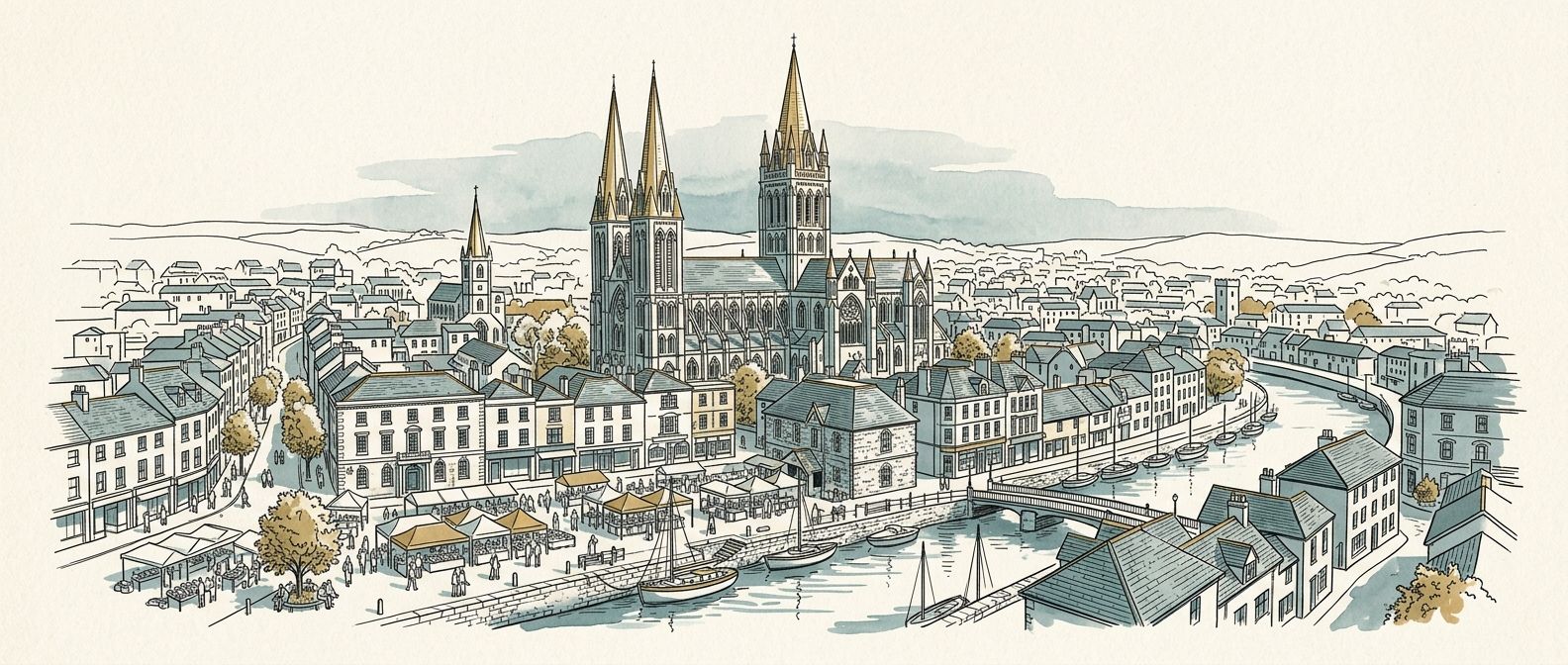
Three spires above a small city. Truro Cathedral is the most visible symbol of the city’s status and one of only three cathedrals in England with three spires (the others are Lichfield and St Mary’s Edinburgh, though Edinburgh is technically Scotland). It was designed by architect John Loughborough Pearson in the Gothic Revival style and built between 1880 and 1910. It was the first cathedral built on a new site in England since Salisbury in the 13th century.
The cathedral replaced the old St Mary’s Church, though one aisle of that medieval church was incorporated into the new building - you can still see it. Pearson died before the cathedral was finished, and his son completed the work. The interior is tall, light and elegant. The south aisle has a memorial to Cornish miners who died underground. It’s a working place of worship, not a museum, and you’ll often hear the organ being practised if you visit mid-week.
The Cathedral (trurocathedral.org.uk) hosts regular concerts, exhibitions and events. The Christmas carol services are a Truro tradition - tickets go fast.
The tin mining era
Tin has been mined in Cornwall since the Bronze Age. By the 1700s, Cornwall was producing most of the world’s tin and copper, and the industry employed tens of thousands. Truro sat at the commercial centre of this trade. The wealth flowing through the town funded grand building projects, civic institutions, and a social scene that rivalled much larger English cities.
The Cornish Mining World Heritage Site (cornishmining.org.uk) covers 20,000 hectares across Cornwall and west Devon, recognised by UNESCO in 2006. While the engine houses and mine stacks are scattered across the county, the money they generated built the elegant streets of Truro. The mining decline of the late 1800s hit Cornwall hard, but Truro survived better than mining towns like Camborne and Redruth because its economy had already diversified into administration, retail and professional services.
Georgian and Victorian Truro
Lemon Street. If you visit Truro, walk up Lemon Street. It’s considered one of the finest Georgian streets in England - a gentle curve of elegant townhouses built in the late 1700s and early 1800s by the Lemon family, who made their fortune in mining. The proportions are beautiful. Many of the buildings are now offices or apartments, but the facades are largely intact.
The Victorian era brought the railway (1859), connecting Truro to London for the first time. It also brought the Royal Cornwall Museum, founded in 1818 and one of Cornwall’s best collections of minerals, archaeology and art. The Victorians built the market hall (still in use), expanded the waterfront, and established many of the civic buildings that define Truro today. Boscawen Street, the main shopping thoroughfare, took its current shape during this period.
The Assembly Rooms and the old City Hall date from the Victorian expansion. Many of Truro’s best buildings were funded by mining wealth in its final flourish before the industry collapsed. Walk the streets between the Cathedral and the river and you’ll see granite facades, carved details and iron railings that speak of a town with money and ambition. The irony is that much of this grandeur was built just as the source of that wealth was running dry.
Modern Truro
The Cathedral Quarter redevelopment brought modern retail alongside the independent shops that have always been Truro’s strength. Lemon Quay - built on what was once a tidal quay where ships loaded tin - now hosts a weekly farmers’ market, seasonal events, and the city’s Christmas lights switch-on. The Hall for Cornwall, a performing arts venue seating over 1,300, reopened in 2021 after a major £26 million refurbishment.
Royal Cornwall Hospital (Treliske) is the county’s main acute hospital, and Truro is home to Cornwall Council’s headquarters at New County Hall. Truro College and Truro School provide education alongside the Cathedral School. The city has more professional service firms - solicitors, accountants, surveyors, financial advisers - than anywhere else in Cornwall.
Truro today - Cornwall’s commercial hub
Truro functions as Cornwall’s administrative, retail, and professional services centre. Cornwall Council, NHS Cornwall, and most of the county’s larger professional firms are based here or have offices in the city. The business community is active, with multiple networking groups, a Business Improvement District, and growing digital and creative sectors.
Transport links are better than most Cornish towns. Truro station sits on the main GWR line to London Paddington (roughly 4.5 hours). The A39 connects to the A30 for road access east. Newquay Airport is 25 minutes away. It’s not London - nowhere in Cornwall is - but for a county that feels remote, Truro offers the best connectivity. The business statistics show why more companies are choosing to base themselves here.
The River Truro and the waterfront
Truro sits at the confluence of the River Kenwyn and River Allen, which merge to form the River Truro (sometimes called the Truro River). This river flows south into the Truro River estuary and eventually into the Fal Estuary - one of the deepest natural harbours in the world. In the medieval period, ships sailed right into the centre of Truro to load tin. The river was the city’s lifeblood.
Today, the waterfront areas have been redeveloped, but you can still walk along the river south towards Malpas, where a seasonal ferry runs to St Mawes and Falmouth. The Heron Inn at Malpas sits at one of the most peaceful spots in mid-Cornwall, with views up the creek that haven’t changed much in centuries. It’s a 30-minute walk from the city centre - through woodlands and along the water - and most visitors never find it.
Truro’s market tradition
Markets have been held in Truro since 1130, when the town received its charter. The current Pannier Market, housed in a Victorian market hall on Lemon Quay, sells local produce, crafts and street food on Wednesdays and Saturdays. A farmers’ market operates on the same site. These markets draw shoppers from across Cornwall and keep Truro’s centre busier than many comparable English towns that have lost their market traditions to supermarkets and online shopping.
The Christmas market deserves a special mention. Each November, Truro hosts a city-wide Christmas celebration that draws tens of thousands. Lights, live music, market stalls, and a torchlit procession through the streets. For a city of 21,000 people, the scale is remarkable. Local businesses depend on it - December trade accounts for a huge chunk of annual revenue for many Truro retailers.
Why Truro Matters to Cornwall
Every county has a centre of gravity. Truro is Cornwall’s. It isn’t the prettiest town (Fowey, St Ives and Padstow win that contest). It isn’t the biggest (by population, Camborne-Pool-Redruth edges it out). But it’s where things happen. Planning decisions, legal proceedings, hospital admissions, council meetings, business deals - they centre on Truro. For anyone doing business in Cornwall, understanding this city means understanding the county’s commercial backbone.
Truro’s population is modest, but its influence stretches across the entire county. The city accounts for a disproportionate share of Cornwall’s professional service employment. Solicitors, accountants, architects, financial advisers - they cluster here because this is where the courts, the council, and the clients are. For the digital economy, Truro’s central position and relatively strong infrastructure make it the natural base for agencies, consultancies, and tech businesses serving clients across the county and beyond.
Frequently Asked Questions
When was Truro Cathedral built?
Construction began in 1880 and the Cathedral was completed in 1910. It was designed by John Loughborough Pearson in the Gothic Revival style and was the first new cathedral built on a fresh site in England since Salisbury Cathedral in the 1220s. The three spires make it visible from miles around and it remains Truro’s defining landmark.
Why is Truro Cornwall’s capital?
Truro’s status comes from centuries of being Cornwall’s administrative and commercial centre. The stannary courts brought legal and financial authority. The tin trade brought wealth. The Cathedral brought city status. Cornwall Council and most county-level institutions are based here. No other Cornish town has the same concentration of governance, professional services and civic infrastructure.
What’s Truro known for?
Truro is best known for its three-spired Cathedral, Georgian architecture (particularly Lemon Street), the Royal Cornwall Museum, and its role as Cornwall’s administrative capital. The Christmas lights and city-wide celebrations each November are a major draw. It’s also known for the Hall for Cornwall theatre, the Pannier Market, and as the headquarters of Cornwall Council. For businesses in Truro, it’s the professional services capital of Cornwall.
Is Truro a good place to live?
For Cornwall, yes. Truro offers the best balance of services, connectivity and amenities in the county. You get shops, restaurants, healthcare, schools and transport links that smaller Cornish towns lack. It’s 20 minutes from the south coast beaches and 30 from the north. The downsides: it’s busier and more expensive than other Cornish towns, parking is tight, and it doesn’t have the coastal charm of Falmouth or St Ives. But for day-to-day living and working, it’s hard to beat.
Need help with this?
We work with Cornwall small businesses on the exact challenges covered in this article. Free 30-minute call, no pressure.
Get in touchCraig Fearn
Director
Craig is Director of Outcome Digital Marketing. He brings over a decade of C-suite advisory experience, having advised senior executives and boards on organisational strategy before focusing on the marketing decisions that move the needle for smaller businesses. As a Fellow of the Royal Society for Public Health (FRSPH) and Fellow of the Chartered Management Institute (FCMI), he applies evidence-based thinking to marketing - helping Cornwall and UK businesses make informed decisions backed by research, not hype.