
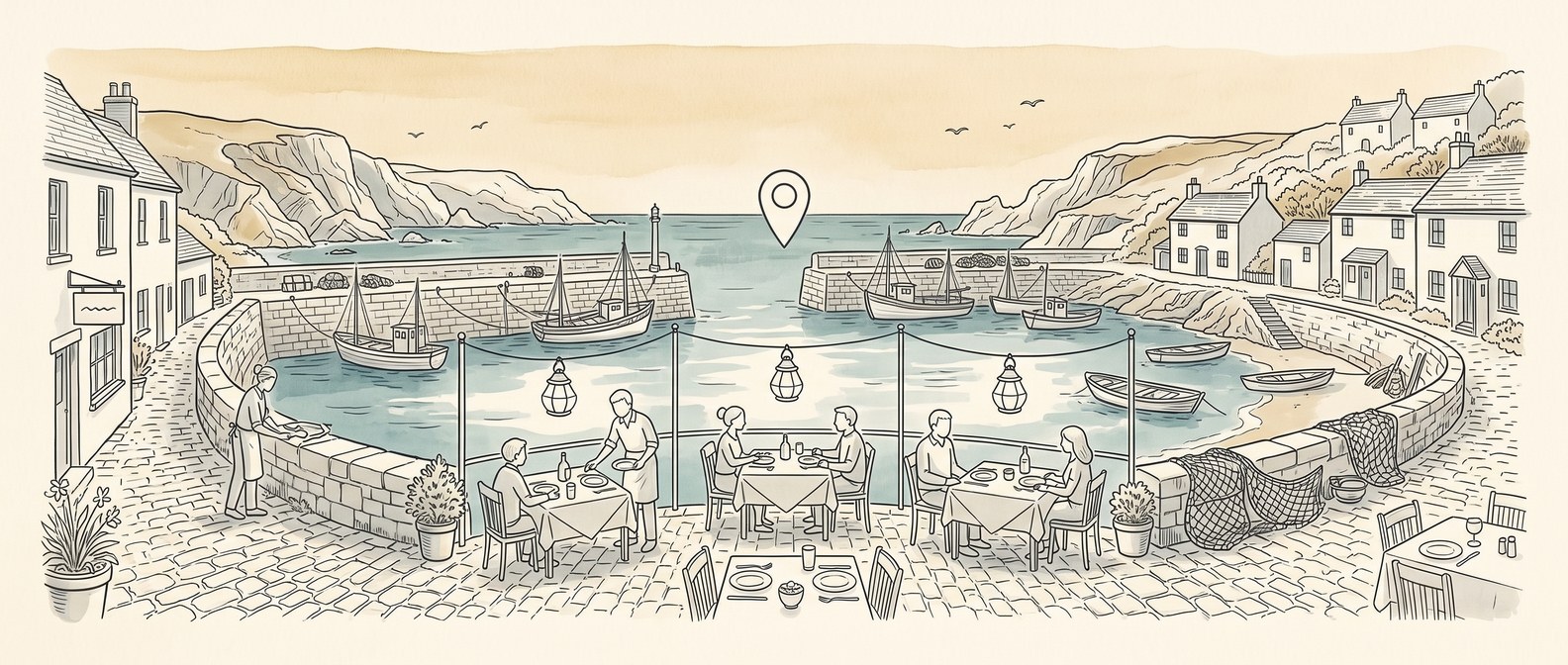
Marketing for Restaurants
Get found for dinner tonight, with Google, your website and the legal basics done properly.
People search “restaurant near me”, “best fish and chips Padstow” or “table for four tonight”. The venues that show up in the map pack with a current menu, honest prices and a way to book get the table. A marketing agency for restaurants should start there, then handle the legal basics on your website. This page covers both. It is not legal advice; check each regulator’s current guidance, linked below. Our full restaurant service is on restaurant marketing in Cornwall.
TL;DR
Start with Google: a complete Business Profile with your menu, booking links and correct hours. Then make sure your website is accurate on prices, allergens and any rules that apply to your size and location. Reviews and local pages do the rest.
Put Your Menu and Bookings on Google
Google’s menu editor is available to food and drink businesses. You can add sections, dishes, descriptions and prices, and Google says changes can take 24 to 48 hours. Its restaurant features include ordering, bookings and waitlists on Google, attributes, and separate delivery and takeout hours. Set them up fully; an incomplete listing gives a competitor the advantage. Our guide to the restaurant Google Business Profile goes through it step by step.
Follow Google’s Profile Guidelines
Google’s representation guidelines say to use your real-world name with no taglines, and that menu links can’t point directly to third-party ordering or delivery services. We check your profile against them before changing anything.
Allergen Information for Online and Phone Orders
The government’s allergen technical guidance says that for online or phone orders, allergen information must be available before purchase and at delivery, free of charge. An online menu is an accepted method. If your menu lives on your site, put allergen information on it.
Calories and Hygiene Ratings
Two rules depend on size and location:
- England. Calorie labelling applies to businesses with 250 or more employees, from 6 April 2022, and includes websites and apps. The required statement is “adults need around 2000 kcal a day”.
- Wales. Takeaway leaflets and menus that allow remote ordering need a bilingual statement pointing to the online hygiene rating, in force from 28 November 2016.
Prices Must Include Everything Non-Optional
The ASA’s advice on prices says prices must include non-optional taxes and charges (CAP 3.18). A menu price that leaves out a compulsory charge is a risk.
Local Pages and the Marketing Around Them
Beyond the legal basics, the work is:
- A fast, mobile-first website with the menu, opening hours and a booking button. See our post on restaurant website design.
- Local landing pages for the areas you draw from.
- Genuine reviews, asked for at the table or by follow-up message.
- A plan that fits your venue, covered in our restaurant marketing strategy guide.
How Local Search Works for a Restaurant
Google shows a map with a short list of businesses above the normal results for local searches. Google says local results are mainly based on relevance, distance and popularity. You cannot change your distance, but you can work on the other two. Relevance comes from choosing the right categories, completing the menu and attributes, and keeping hours accurate. Popularity comes from genuine reviews and consistent details across the web.
For a restaurant, the practical work is keeping the menu on Google and on your website identical, so a guest never sees one price on Google and another on your site. Special hours for bank holidays and events matter too, because a wrong “open” label sends people to a closed door.
Pages Every Restaurant Site Needs
- A menu page in real text, not just a PDF or an image, with prices and allergen information.
- A booking page or a clear booking button on every page.
- A page for private dining or events, if you offer them.
- A location and opening hours page, with the map and parking or access notes.
- A page for any delivery or takeaway service, with its own hours if they differ.
Keep these pages current. A stale menu or price is both a compliance problem and a trust problem.
Reviews and Testimonials: the Rules
Fake reviews are now banned. The ban came into force on 6 April 2025 (commencement order). It covers submitting or commissioning fake reviews, and hiding the fact that a review was incentivised (Schedule 20 of the Act). The CMA can fine up to 10% of global turnover, according to its announcement of the new regime. If an SEO agency offers to “get you reviews” for a fee, walk away.
The advertising rules point the same way. Under the CAP Code you must hold evidence that a testimonial is genuine, and you must make clear when reviews were incentivised.
Google’s own policy says you must not offer incentives for reviews, but sending customers a review link or a QR code is allowed (Google Business Profile Help).
What to Do Next
Check your Google listing and website against the list above, then build the profile, pages and reviews. For all of it done for you, see restaurant marketing in Cornwall or all industries.
What SEO costs
Essential SEO
£299/month
- Keyword research & monitoring (5-10 keywords)
- On-page optimisation (up to 5 pages)
- Basic technical SEO audit
- Monthly ranking report
- Email support
Professional SEO
£799/month
- Everything in Essential, plus:
- Keyword research & monitoring (20+ keywords)
- On-page optimisation (unlimited pages)
- Technical SEO + speed optimisation
- 2 blog posts/month included
- Link building (5-10 quality links/month)
- Monthly strategy call
- Slack support
Cancel anytime, no long-term contracts. See SEO pricing.
SEO for Restaurants: Common Questions
How much does restaurant marketing cost?
How do I put my menu on Google?
Do I need to show allergen information online?
Do I have to show calories on my website?
Do you do more than search?
Related Pages
Restaurant Marketing in Cornwall
Our restaurant service, for Cornish venues.
Local SEO Services
Map pack, Google Business Profile and citations, explained.
Restaurant Google Business Profile
Set up and optimise your listing step by step.
Restaurant SEO and Local Search
How restaurants get found on Google.
SEO by Industry
Guides for trades, health, hospitality and property.
Ready to Fill More Tables at Your Restaurant?
That's exactly where most good conversations start. No pitch, no pressure - just a straight talk about what you're trying to build and whether we can actually help.
No long-term contracts · Cancel any time · Transparent monthly reporting
Or call us: 07593 551341