
Written by Craig Fearn
Director
Last updated: 26 March 2026
SEO is the process of improving your website so it appears higher in Google search results when potential customers search for what you offer. Organic search delivers 53.3% of all website traffic, making it the single largest source of visitors for most businesses. This SEO fundamentals guide covers every concept UK small business owners need - without jargon - and shows where SEO sits inside a wider digital marketing plan.
TL;DR: Organic search drives 53.3% of all website traffic (SEO Inc). SEO leads close at 14.6% compared with 1.7% for outbound methods (SeoProfy). And 98% of consumers now search online to find local businesses (BrightLocal). If your website isn’t optimised, you’re invisible to people actively looking for your services.
We have structured this guide around the questions business owners actually ask. Whether you’re wondering what SEO actually means or ready to work through our practical optimisation checklist, you’ll find clear answers here. From our work with Cornwall and Devon businesses, we know that understanding these fundamentals is the difference between a website that generates enquiries and one that simply exists.
What Exactly Is SEO and Why Should You Care?
SEO stands for search engine optimisation - the practice of making your website more visible when people search for your products or services on Google. The top organic result receives a click-through rate of nearly 40%, while results on page two get almost none, according to First Page Sage.
Think about how you find businesses. You type something into Google. You click one of the first few results. That is it. If your website does not appear on page one, most potential customers will never find you. SEO is not magic - it is a combination of technical fixes, quality content, and building your site’s reputation. Some changes take minutes. Others require months of consistent work. But the payoff is customers finding you without paying for every click.
For UK small businesses specifically, the opportunity is real. According to Page Optimizer Pro, 61% of small businesses aren’t investing in SEO at all - which means those who do gain a genuine competitive advantage.
How Does Search Engine Optimisation Actually Work?
Google’s algorithms evaluate hundreds of factors to decide which pages best answer a search query. The process follows three stages - crawling, indexing, and ranking - and understanding each one helps you see where your site might be falling short.
Crawling
Google sends automated programs called crawlers to read your website’s pages. They follow links from page to page, discovering your content. If your site has broken links, poor navigation, or pages blocked from crawling, Google simply will not find them. Clean URL structures and logical internal linking help crawlers find everything.
Indexing
After crawling, Google indexes your content - storing information about what each page covers, what keywords it targets, how fresh it is, and how it connects to other pages. Think of it as Google’s library catalogue. Pages with thin content, duplicate text, or no clear purpose may be crawled but not indexed, meaning they will never appear in search results.
Ranking
When someone searches, Google’s algorithm matches their query against its index and ranks results by relevance and quality. Google’s own documentation explains that Google uses factors including content quality, page speed, mobile-friendliness, and how many other reputable sites link to you. No single factor dominates - it is the combination that matters.
What Are the Three Main Types of SEO?
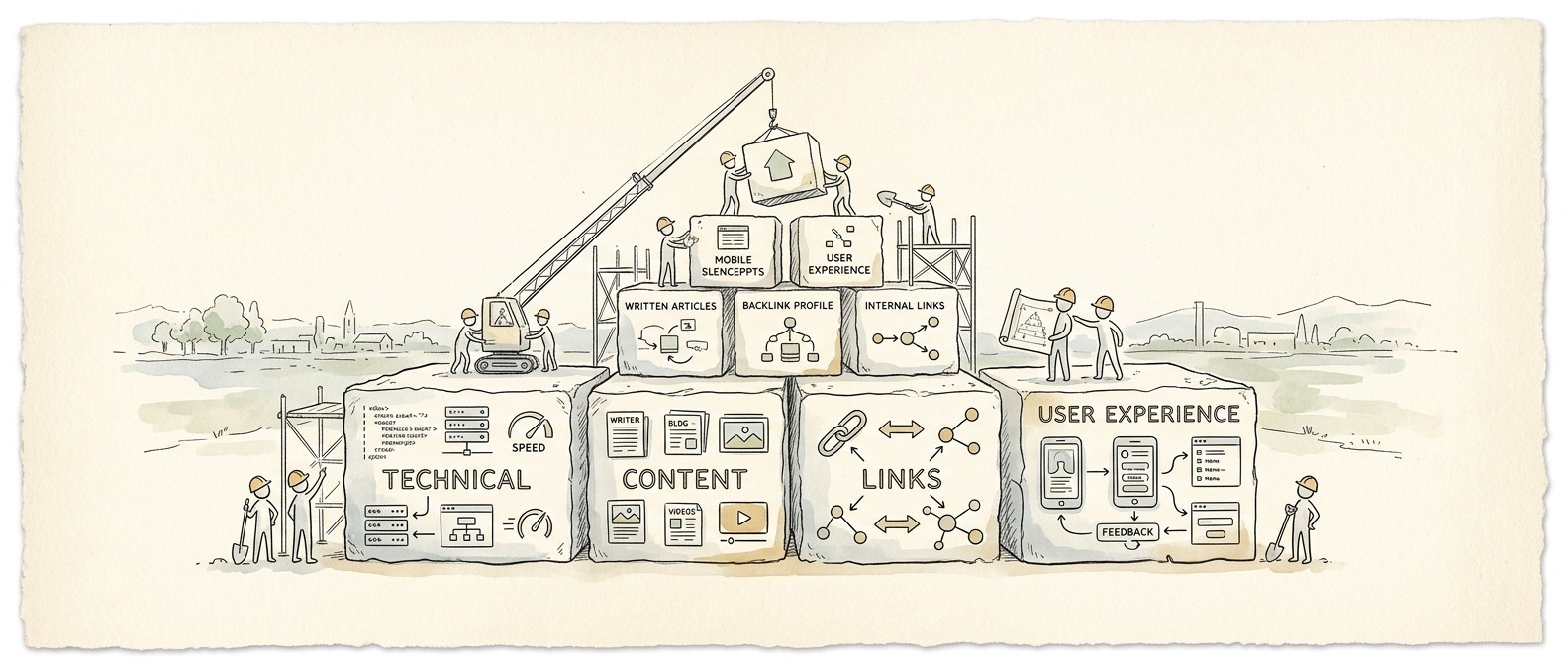
SEO breaks down into three categories: technical, on-page, and off-page. Each addresses a different part of how search engines evaluate your site. Getting all three right is what separates page-one results from everything else.
| SEO Type | What It Covers | DIY Difficulty | Impact Timeline |
|---|---|---|---|
| Technical SEO | Site speed, HTTPS, mobile-friendliness, crawlability | Moderate to Hard | Weeks |
| On-Page SEO | Title tags, content, headings, images, internal links | Easy to Moderate | Weeks to Months |
| Off-Page SEO | Backlinks, citations, reviews, brand mentions | Hard | Months |
Technical SEO
Technical SEO covers the backend foundations. Fast loading speeds. Secure connections (HTTPS). Mobile-friendly design. Clean URL structures that Google can read easily. Get these wrong and nothing else matters. According to SQ Magazine, mobile traffic now represents 56.86% of UK web traffic, so your website design choices directly determine whether Google can properly assess your site.
On-Page SEO
On-page SEO focuses on individual pages. Title tags, headings, content quality, internal links, image alt text, meta descriptions. It is about making each page as relevant and useful as possible for specific search terms. According to First Page Sage’s 2025 ranking factors study, consistent publication of satisfying content remains Google’s top-weighted ranking signal. Check our on-page SEO checklist for the complete breakdown.
Off-Page SEO
Off-page SEO happens outside your website. Other sites linking to yours. Mentions in articles. Local citations in business directories. These external factors tell Google your site is trustworthy and authoritative. For UK small businesses, local off-page SEO - directories, industry listings, local press mentions - often matters more than chasing national backlinks. Our content marketing guide explains how to earn links through genuinely useful content.
How Does User Experience Affect Your Search Rankings?
Google has confirmed that user experience signals influence which page wins each search result. If your site is slow, awkward on mobile, or hard to navigate, Google will quietly favour a competitor’s page that feels easier to use - even when your content is stronger.
The clearest signals are Core Web Vitals - a set of three measurable metrics covering loading speed, visual stability, and how quickly a page responds to a tap or click. Google’s own documentation explains how each metric is scored and which thresholds count as “good.” Mobile-friendliness sits alongside these as a baseline requirement, especially with most UK searches now happening on phones.
We’ve found that fixing usability issues often delivers the fastest wins for small business sites. Compress oversized images. Remove tracking scripts you aren’t using. Make sure buttons are big enough to tap on a small screen. These are SEO strategies that don’t need new content or backlinks - they just make the page Google already ranks work harder. A better experience for users and search engines alike also lifts conversion rates, so the same fixes that help your search result position also help visitors actually become customers.
What About Local SEO?
Local SEO targets customers searching for businesses in a specific area, and it’s where small businesses hold the biggest advantage over large competitors. There are over 1.5 billion “near me” searches every month globally, according to SeoProfy.
When someone searches “plumber near me” or “coffee shop Truro,” Google shows results based heavily on proximity and local relevance. This means a one-person business can outrank national chains in their area. The key tools are your Google Business Profile, local citations (consistent name, address, phone number across directories), and localised website content. According to BrightLocal, 76% of people who search for something nearby on their phone visit a business within a day.
If you serve customers in a specific region, local SEO should be your first priority. Read our full What is Local SEO? guide or see how local SEO works in Cornwall for a real-world example.
What Keywords Should You Target?
Target the words your customers actually type into Google, not the industry jargon you use internally. The gap between professional terminology and customer language is where most small businesses lose out on search traffic.
Think Like Your Customer
A heating engineer might call it “boiler servicing and maintenance,” but their customers search for “boiler repair near me” or “fix my boiler.” Free keyword research tools help you discover exactly what terms have real search volume. From our work with Cornwall businesses, we often find that the terms owners assume customers use are completely different from what people actually type.
Long-Tail vs Short-Tail Keywords
Short keywords like “plumber” have massive search volume but impossible competition. Long-tail keywords like “emergency plumber Truro evenings” have less volume but much higher intent - someone searching that is ready to hire. For small businesses, long-tail keywords with local modifiers are where the real opportunities sit. They are easier to rank for and convert better because the searcher knows exactly what they want.
How Much Does SEO Cost in the UK?
SEO costs range from free (DIY with free tools) to £1,500+/month for professional management. For most UK small businesses, the sweet spot sits between £300 and £800 per month.
Basic improvements - fixing title tags, claiming your Google Business Profile, writing better content - cost nothing but your time. Professional SEO services for small businesses typically run £300–£800/month. Competitive industries or larger sites with technical issues may require more. Be cautious of anyone charging less than £200/month - at that price, you’re unlikely to get meaningful work. Our detailed breakdown of how much SEO costs in the UK covers what different budgets buy.
Common SEO Mistakes That Waste Your Time
Knowing what not to do saves as much time as knowing what to do. These are the mistakes we see most often when auditing small business websites across Cornwall and Devon.
- Stuffing keywords unnaturally. Writing “best plumber London best plumber in London area” does not help - it hurts. Google’s algorithms detect forced repetition and penalise it. Write for people first.
- Ignoring mobile. With 56.86% of UK web traffic coming from mobile devices (SQ Magazine), a site that is frustrating on phones loses more than half its potential visitors.
- Chasing vanity metrics. Rankings for obscure terms nobody searches, or traffic that never converts, aren’t worth celebrating. Focus on keywords your actual customers use.
- Expecting overnight results. SEO compounds over months. Businesses that quit after four weeks never see the payoff. Those that stay consistent for six months rarely regret it.
- Neglecting existing content. Updating and improving pages you already have often delivers faster results than creating new ones. Review what is underperforming before writing from scratch.
- Buying cheap backlinks. Spammy link-building schemes can result in manual penalties from Google. Earn links through quality content and genuine relationships instead.
How Long Before You See Results from SEO?
Most businesses see meaningful results in 3–6 months of consistent work. Technical fixes often show improvements within weeks, while building authority through backlinks is measured in months.
Fix a slow website, and Google notices quickly. Content changes take longer - Google needs to recrawl, reindex, and test your pages against competitors. According to Backlinko, the average page ranking in Google’s top 10 results is over two years old, which shows why patience matters.
Anyone promising page one rankings in 30 days is either lying or using tactics that risk penalising your site. Real SEO takes time. But unlike paid advertising, the results compound. Traffic you earn through SEO keeps coming even when you stop paying. Read our guide on how long SEO takes for detailed timelines by industry.
Should You Do SEO Yourself or Hire Someone?
You can handle basic SEO yourself with free resources and tools. Complex or competitive situations benefit from professional help - but understanding the fundamentals means you’ll always know whether an agency is delivering real value.
What You Can Do Yourself
Learning SEO basics is absolutely worth your time. Claiming and optimising your Google Business Profile, writing helpful content, getting reviews, and fixing obvious website issues are all manageable without expertise. Many improvements require no technical skills - just research and good writing. Use our on-page SEO checklist as a starting point and our free SEO tools guide for the software you’ll need.
When to Get Professional Help
Professional help makes sense when you’re competing in tough markets, lack time to do it properly, or need technical fixes beyond your skills. Signs you need help include declining rankings you can’t diagnose, a website redesign that needs SEO input, or competitors consistently outranking you despite your content being better.
The key is finding someone who explains what they’re doing rather than hiding behind jargon. Our SEO services focus on transparency - you’ll always know what we’re doing and why. For Cornwall businesses specifically, see our guide to SEO in Cornwall or our advice on choosing an SEO agency.
What Is the Difference Between SEO and Paid Advertising?
SEO earns organic visibility over time. Paid ads buy immediate visibility that stops the moment you stop paying. According to SeoProfy, SEO delivers roughly twice the return on investment of pay-per-click advertising over time.
Both have their place. Paid advertising (PPC) works when you need customers today. Launch a new business, run a promotion, test a new market - ads deliver immediate traffic. But you are paying for every click, and costs add up quickly. SEO builds lasting value. The work you do today keeps paying off months and years later. For most small businesses, the strongest marketing strategies pair both - ads for immediate needs, SEO for long-term growth. Our SEO vs PPC comparison breaks down when each makes sense.
How Do You Measure Whether Your SEO Is Working?
Two free tools from Google answer almost every question a small business owner needs to ask about SEO performance: Google Search Console and Google Analytics. Both are free, both connect in minutes, and between them they show what people search for, which pages they land on, and what they do next.
Google Search Console
Google Search Console is the dashboard Google gives you to see your site through Google’s eyes. It shows every search query that triggered an impression for your pages, your average search result position for each one, and how often people click through. If a page is buried on page two of the search result for a keyword you care about, Search Console will tell you. It also flags indexing problems, mobile issues, and Core Web Vitals failures - the technical errors that quietly suppress organic traffic until someone fixes them.
Google Analytics
Google Analytics picks up where Search Console stops. Once a visitor lands on your site, it tracks where they go, how long they stay, and whether they convert into an enquiry or sale. The combination is powerful: Search Console tells you which SEO strategies are pulling people in from search, and Analytics tells you which of those visitors actually become customers. Set up a goal for form submissions or phone clicks and you can finally answer the question every owner asks - is the organic traffic actually worth anything?
Check both tools at least once a month. Look for pages where impressions are climbing but clicks aren’t - that usually means your title tag or meta description needs sharpening. Look for pages with high traffic but a high bounce rate - that usually means the content doesn’t match the search intent behind the queries pulling visitors in. Small adjustments based on real data beat guesswork every time.
If you’re a beginner and the dashboards look intimidating, ignore most of the menus. Stick with the “Performance” report in Search Console and the “Traffic acquisition” report in Analytics. Between them, those two views answer 90% of the questions a small business actually has about its organic traffic. Pair them with one free keyword research tool such as Google Ranking Checker or Google Trends and you’ve got a complete free tool stack covering both the search queries pulling people in and what those visitors do once they arrive.
Frequently Asked Questions About SEO
What is the most important SEO ranking factor?
Consistent publication of helpful, satisfying content is the highest-weighted factor in Google’s algorithm according to First Page Sage’s 2025 ranking factors study. Technical foundations like site speed and mobile-friendliness must be in place, but content quality is what ultimately determines your rankings.
How much traffic does organic search actually drive?
Organic search delivers 53.3% of all website traffic across industries, according to SEO Inc’s analysis. For comparison, paid search contributes roughly 15% and social media around 5%. This makes organic search the single largest traffic source for most business websites.
Is SEO still worth it with AI search features?
Yes. While AI Overviews now appear for around 13% of queries according to industry tracking, organic search still drives the majority of website traffic. The businesses that create genuinely helpful content remain visible because Google still needs quality sources to power those AI answers.
Can a small business compete with larger companies in SEO?
Absolutely, particularly in local search. Large companies rarely optimise for town-level keywords like “electrician Falmouth” or “restaurant Truro.” With 61% of small businesses not investing in SEO at all, those who do face less competition than you might expect.
Do I need a blog for SEO to work?
Not necessarily, but blogs give you additional pages that can rank for additional keywords. Each blog post is another entry point for potential customers to find your site through search. Our guide on whether blogs help SEO covers when blogging is worthwhile and when it’s a distraction.
What is the difference between local SEO and regular SEO?
Local SEO targets location-specific searches like “plumber near me” and relies heavily on your Google Business Profile, reviews, and local citations. Regular SEO targets broader searches without geographic intent. Most UK small businesses benefit more from local SEO because their customers are nearby.
Ready to Start Improving Your SEO?
SEO success comes from consistent effort, not quick fixes. Start with the fundamentals: a fast, mobile-friendly website with useful content that answers what your customers are searching for. For businesses ready to invest in professional help, seoservicesuk.co.uk provides an overview of what UK SEO services typically include. Here is a recommended path based on where you are right now.
If You Are Brand New to SEO
Start with What is SEO? for the core concepts, then work through SEO for Beginners for step-by-step guidance using free resources. If you’re still unsure whether it’s worth the investment, Why Does My Website Need SEO? makes the business case clearly.
If You Are Ready to Take Action
Our guide to improving your website SEO gives you practical steps, and the on-page SEO checklist ensures you don’t miss anything. Grab the free SEO tools you’ll need, and understand realistic timelines for results so you know what to expect.
If You Want to Go Deeper
Explore the technical side with URL structure best practices, how domain names affect SEO, and the relationship between design and SEO. If you are working with a simple site, our guide to SEO for one-page websites covers what is different. For content strategy, Do Blogs Help SEO? answers the question definitively. And if you are weighing up your options, our SEO vs PPC comparison helps you allocate your marketing budget wisely.
If You Serve a Local Area
Local SEO deserves its own strategy. Read What is Local SEO? for the fundamentals, then see how local SEO works in Cornwall for a practical example of location-specific optimisation. Use a free ranking checker to monitor your local positions as you implement changes. Need help? Our SEO services deliver results without the jargon, or get in touch for a free initial conversation.
Need help with this?
We work with Cornwall small businesses on the exact challenges covered in this article. Free 30-minute call, no pressure.
Get in touchCraig Fearn
Director
Craig is Director of Outcome Digital Marketing. He brings over a decade of C-suite advisory experience, having advised senior executives and boards on organisational strategy before focusing on the marketing decisions that move the needle for smaller businesses. As a Fellow of the Royal Society for Public Health (FRSPH) and Fellow of the Chartered Management Institute (FCMI), he applies evidence-based thinking to marketing - helping Cornwall and UK businesses make informed decisions backed by research, not hype.