Written by Craig Fearn
Director
Last updated: 9 July 2026
Part of our complete guide: Digital Marketing in Cornwall: The Local Playbook Agencies Do Not Want You to Read
Amazon advertising is a set of paid ad formats that let sellers promote products inside Amazon’s own search results and product pages. The most common, Sponsored Products, works like a search ad: you bid to appear at the top of relevant Amazon searches and pay when someone clicks. The difference from advertising anywhere else is intent — the person seeing your ad is already on Amazon, card in hand, ready to buy. This guide explains how it works, why it has become so big, and whether it is worth it for you.
TL;DR
Amazon advertising puts your products at the top of Amazon search results — you bid, and pay per click. The key metric is ACOS (Advertising Cost of Sales): the share of ad-driven revenue you spent to get it. It is only relevant if you actually sell on Amazon; if you sell through your own website, your budget belongs there instead. For Amazon sellers, ads have become almost unavoidable — but only profitable if your margins and ACOS are managed tightly.
How Amazon Ads Work
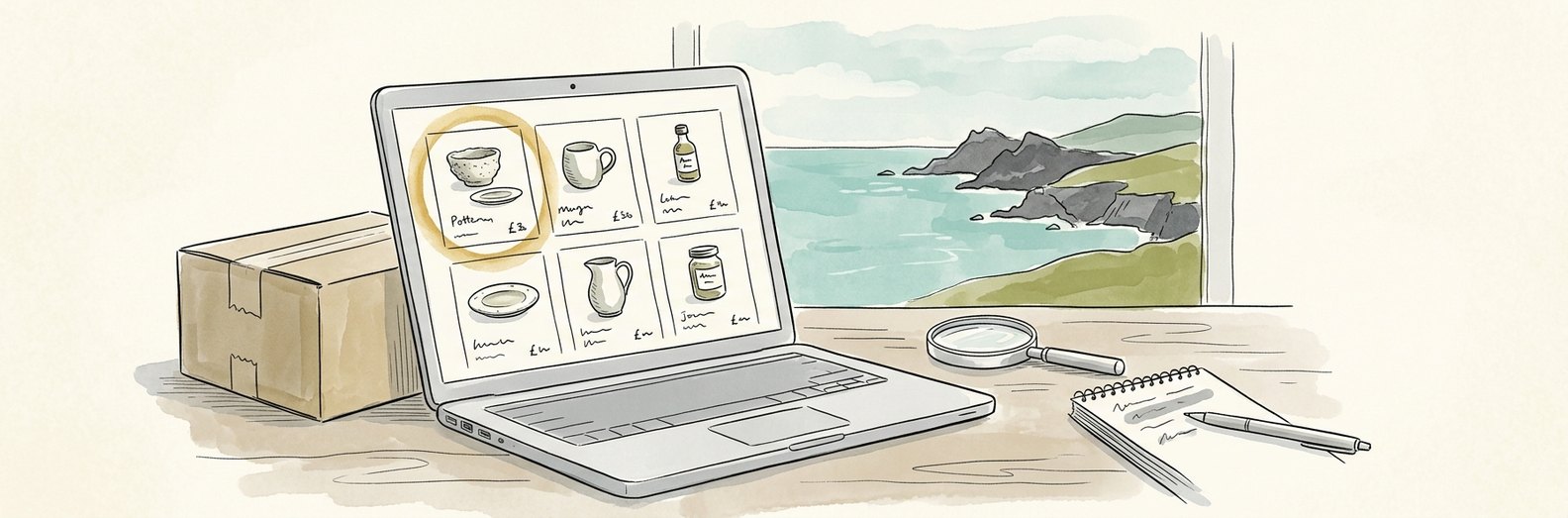
The workhorse is Sponsored Products. You pick products to promote, choose the search terms you want to show up for, set a bid, and your listing appears at the top of those Amazon searches marked “Sponsored”. You pay only when someone clicks. There are other formats — Sponsored Brands for a banner with your logo, Sponsored Display for retargeting shoppers around the web — but Sponsored Products is where most sellers start and spend.
The metric that governs everything is ACOS, Advertising Cost of Sales: the percentage of your ad-driven revenue that went on the ads. Spend £20 to make £100 and your ACOS is 20%. Whether that number is healthy or ruinous is set entirely by your product margin — fat margins can carry a high ACOS and still profit, while a thin-margin product can be quietly losing money at the very same figure. Getting this right is the whole game.
Why Amazon Ads Got So Big
Advertising on Amazon has quietly become one of the largest ad businesses on the planet — and for product sellers, one of the hardest to ignore.
Amazon made over $68 billion in advertising revenue across 2025 (Marketing Dive, 2026), with $21.3 billion in the final quarter alone, up 22% year on year (Amazon Q4 2025 / CNBC, 2026). It now controls more than three-quarters of all US retail media ad spend (eMarketer, 2026).
The reason sellers can’t easily opt out is that so much shopping now begins on Amazon rather than Google. One US survey found 57% of online shoppers start their product searches on Amazon, ahead of 42% who start on a search engine — though that figure is from 2023, so treat it as a direction of travel rather than a current-year number (Jungle Scout / eMarketer, 2023). When buyers start on Amazon, the paid slots at the top of its results are prime real estate, and organic visibility alone rarely gets a new product seen.
Amazon’s US retail media revenue is forecast to grow 17.9% in 2026 — faster than Meta (14.2%) or Google (5.6%) (eMarketer, 2026). (These are US market figures; Amazon does not publish a separate UK breakdown, so treat them as the global direction rather than exact UK numbers.)
Is It Worth It for You?
Start with one question: do you actually sell on Amazon? If not, Amazon advertising is irrelevant, and your money belongs in your own online store’s SEO and Google Ads instead. There is no point advertising on a marketplace you are not on.
If you do sell on Amazon, ads are increasingly part of the cost of competing there, because winning visibility organically has become harder. Whether they pay comes down to two things: your margins and how tightly you manage ACOS. A seller with healthy margins and a well-optimised listing — good title, images, reviews, and price — can make Amazon ads one of the highest-intent channels going. A thin-margin product, or a poor listing that ads simply send traffic to, will burn budget.
So — Amazon advertising is powerful precisely because the buyer is already there, card in hand. But it only makes sense if you sell on the platform, and it only pays if you keep an eye on the numbers underneath it. Selling through your own website instead? Build there. A well-built ecommerce site with proper marketing behind it keeps you in control of both the customer and the margin — which is the one thing Amazon never quite lets you have.
Need help with this?
We work with Cornwall small businesses on the exact challenges covered in this article. Free 30-minute call, no pressure.
Get in touchCraig Fearn
Director
Craig is Director of Outcome Digital Marketing. He brings over a decade of C-suite advisory experience, having advised senior executives and boards on organisational strategy before focusing on the marketing decisions that move the needle for smaller businesses. As a Fellow of the Royal Society for Public Health (FRSPH) and Fellow of the Chartered Management Institute (FCMI), he applies evidence-based thinking to marketing - helping Cornwall and UK businesses make informed decisions backed by research, not hype.